Showing posts with label Academic. Show all posts

Monday, November 19, 2018

Hitler’s Death

In The Death of Hitler, author and expert Luke Daly-Groves rigorously looks at the question:Did Hitler shoot himself in the Führerbunker or did he slip past the Soviets and escape to South America? Countless documentaries, newspaper articles, and internet pages written by conspiracy theorists have lead the ongoing debate surrounding Hitler's last days. Historians have not yet managed to make a serious response. Until now.

This book is the first attempt by an academic to return to the evidence of Hitler's suicide in order to scrutinise the arguments of conspiracy theorists using scientific methods. Through analysis of recently declassified MI5 files, previously unpublished sketches of Hitler's bunker, personal accounts of intelligence officers along with stories of shoot-outs, plunder and secret agents, this rigorously researched book takes on the doubters to tell the full story of how Hitler died.
Conspiracy theorists are plentiful.  The conspiracies regarding Hitler, even after so many years, are still very active.  These conspiracies are more damaging than those of the flat earth society.  The flat-earthers do not support the growth of evil.  Hitler conspiracies aid the growth of evil.

Daly-Groves has written an excellent book covering the historical evidence in a deeper and academically satisfying manner regarding the time and method of Hitler's death.  He provides previously unavailable documentation the completely closes the question of Hitler's possible survival and the cowardice of his death.

My only problem with Daly-Groves's book is in the first two chapters.  These are obviously from one of his thesis papers.  The writing is stale and uninvolving.  The rigor of the research is very clear in these chapters, but they read very much like a dissertation, not a popular history text.

Saturday, September 22, 2018

The Vikings

The favorite image of the Vikings is of tall red-headed men, raping and pillaging their way around the coast of Europe, stopping only to ransack monasteries and burn longships. But the violent Vikings of the 8th century became the pious Christians of the 11th century, who gave gold crosses to Christian churches and in whose areas of rule pagan idols were destroyed and churches were built. So how did this radical transformation happen, and why? What difference did it make to the Vikings, and to those around them, and what is their legacy today? This book takes a global look at this crucial period in Viking history, exploring all the major areas of Viking settlement. Written to be an accessible and engaging overview for the general reader.
I visited far northern Norway in 1996.  Norway brings to mind Vikings.  The coast, fjords, architecture, and the language drips with the thought of Vikings.  Many people are enamored with the view of Vikings.  I am not one of those people.  The subtitle of this book is what interested me.  How did the Norse people go from being raiders to Christian in a relatively short period of time?  Martyn Whittock and Whittock tell the story of these people well.

Reading a history textbook does not sound enjoyable.  Most times it is not fun.  The tale of the Vikings becoming a Christian people is interesting.  Whittock and Whittock performed yeoman's work in research.  Their presentation goes beyond a research book.  There are few, if any, stories of individual Norse people but it is easy to view these people and the change their world must have gone through.

This book is an easy read for someone with interest in Viking history.  I believe this book would make an excellent addition to an academic course in any medieval history of Europe also.

Saturday, September 1, 2018

Accessible America

A History of Disability and Design
by Bess Williamson
Description
A history of design that is often overlooked—until we need it Have you ever hit the big blue button to activate automatic doors? Have you ever used an ergonomic kitchen tool? Have you ever used curb cuts to roll a stroller across an intersection? If you have, then you’ve benefited from accessible design—design for people with physical, sensory, and cognitive disabilities. These ubiquitous touchstones of modern life were once anything but. Disability advocates fought tirelessly to ensure that the needs of people with disabilities became a standard part of public design thinking. That fight took many forms worldwide, but in the United States it became a civil rights issue; activists used design to make an argument about the place of people with disabilities in public life. In the aftermath of World War II, with injured veterans returning home and the polio epidemic reaching the Oval Office, the needs of people with disabilities came forcibly into the public eye as they never had before. The U.S. became the first country to enact federal accessibility laws, beginning with the Architectural Barriers Act in 1968 and continuing through the landmark Americans with Disabilities Act in 1990, bringing about a wholesale rethinking of our built environment. This progression wasn’t straightforward or easy. Early legislation and design efforts were often haphazard or poorly implemented, with decidedly mixed results. Political resistance to accommodating the needs of people with disabilities was strong; so, too, was resistance among architectural and industrial designers, for whom the accessible design wasn’t “real” design. Williamson provides an extraordinary look at the everyday design, marrying accessibility with aesthetic, to give an insight into a world in which we are all active participants, but often passive onlookers. Richly detailed, with stories of politics and innovation, Bess Williamson’s Accessible America takes us through this critical history, showing how American ideas of individualism and rights came to shape the material world, often with unexpected consequences.
Most would look at a book about the history of design in America as strictly an academic text for research or design courses.  And this book is an excellent resource for both research and teaching.  I am neither a researcher in disability design nor a student of industrial design.  Though I am not a member of the apparent intended audience, I thoroughly enjoyed this book.

A am an American with a disability that requires that I use a wheelchair.  I have benefited and continue to benefit from the history of accessibility in the United States.  It may be due to my imposed passion for accessibility that this book was so impactful and meaningful to me.  This book educated me about those who paved the curb-cut and reasonable sloped road that I now get to travel down.  These individuals are no longer unknown to me but are people I am now thankful to and for.

Monday, August 13, 2018

A German Officer in Occupied Paris

Ernst Jünger was one of twentieth-century Germany’s most important—and most controversial—writers. Decorated for bravery in World War I and the author of the acclaimed memoir from the western front, Storm of Steel, he frankly depicted the war’s horrors even as he extolled its glories. As a Wehrmacht captain during the Second World War, Jünger faithfully kept a journal in occupied Paris and continued to write on the eastern front and in Germany until its defeat—writings that are of major historical and literary significance.

Jünger’s Paris journals document his Francophile excitement, romantic affairs, and fascination with botany and entomology, alongside mystical and religious ruminations and trenchant observations on the occupation and the politics of collaboration. Working as a mail censor, he led the privileged life of an officer, encountering artists such as Céline, Cocteau, Braque, and Picasso. His notes from the Caucasus depict chaos and misery after the defeat at Stalingrad, as well as candid comments about the atrocities on the eastern front. Returning to Paris, Jünger observed resistance and was peripherally involved in the 1944 conspiracy to assassinate Hitler. After fleeing France, he reunited with his family as Germany’s capitulation approached. Both participant and commentator, close to the horrors of history but often hovering above them, Jünger turned his life and experiences into a work of art. These wartime journals appear here in English for the first time, giving us fresh insight into the quandaries of the twentieth century from the keen pen of a paradoxical observer.

Ernst Jünger (1895–1998) was a major figure in twentieth-century German literature and intellectual life. He was a young leader of right-wing nationalism in the Weimar Republic, but although the Nazis tried to court him, Jünger steadfastly kept his distance from their politics. Among his works is On the Marble Cliffs, a rare anti-Nazi novel written under the Third Reich.
I had never before heard of Junger.  The book is mostly a collection of his journals over his stationing as an officer in Paris.  Given that, it reads like a diary.  Since I was not aware of Junger before reading, the book did not engage me.  Reading the journal of someone I don't know isn't interesting.  What was very interesting was his view as a German officer in the war.

I do not believe that Junger was a Nazi, but a German.  Many times in his journals it was clear that he did not support the fascist ideals. Knowing that he had burned many of his letters, he was likely cautious with what he recorded in his journals.

This book is an academic collection and is an excellent resource for history students an researchers.  For entertainment reading, I cannot recommend.

Monday, July 30, 2018

On Writing: A Memoir Of The Craft

Immensely helpful and illuminating to any aspiring writer, this special edition of Stephen King’s critically lauded, million-copy bestseller shares the experiences, habits, and convictions that have shaped him and his work.

“Long live the King” hailed Entertainment Weekly upon publication of Stephen King’s On Writing. Part memoir, part master class by one of the bestselling authors of all time, this superb volume is a revealing and practical view of the writer’s craft, comprising the necessary tools of the trade every writer must have. King’s advice is grounded in his vivid memories from childhood through his emergence as a writer, from his struggling early career to his widely reported, near-fatal accident in 1999—and how the inextricable link between writing and living spurred his recovery. Brilliantly structured, friendly and inspiring, On Writing will empower and entertain everyone who reads it—fans, writers, and anyone who loves a great story well told.
I bought this book after walking through a local brick and mortar bookstore.  This book was listed as required reading for a high school creative writing class.  I was quite surprised that Stephen King had written a book on writing and that the book was needed for a high school class.  My interest peaked, I bought it.  I was not disappointed.

King provides an autobiographical portion as his C.V.  From this, I came to understand King and his writing.  All authors, like all characters, have a backstory.  His is not pleasant.

He also provides excellent help for fiction writers, the pitfalls to avoid, and an encouragement for writing.  His directions for first steps for the author desiring to be published are invaluable.  I can recommend this book to anyone who enjoys writing fiction for personal enjoyment and to the aspiring professional fiction writer.

Monday, April 2, 2018

The Brink

The incredible story of the 1983 war game that triggered a tense, brittle period of nuclear brinkmanship between the United States and the former Soviet Union.

What happened in 1983 to make the Soviet Union so afraid of a potential nuclear strike from the United States that they sent mobile ICBMs (intercontinental ballistic missiles) into the field, placing them on a three-minute alert?

Marc Ambinder explains the anxious period between the United States and the Soviet Union from 1982 to 1984, with the “Able Archer ’83” war game as the fulcrum of the tension. With astonishing and clarifying new details, he recounts the scary series of the close encounters that tested the limits of ordinary humans and powerful leaders alike. Ambinder explains how political leadership ultimately triumphed over misunderstandings, helping the two countries maintain a fragile peace.

Ambinder provides a comprehensive and chilling account of the nuclear command and control process, from intelligence warnings to the composition of the nuclear codes themselves. And he affords glimpses into the secret world of a preemptive electronic attack that scared the Soviet Union into action. Ambinder’s account reads like a thriller, recounting the spy-versus-spy games that kept both countries—and the world—in check.

From geopolitics in Moscow and Washington to sweat-caked soldiers fighting in the trenches of the Cold War, to high-stakes war games across NATO and the Warsaw Pact, The Brink serves as the definitive intelligence, nuclear, and national security history of one of the most precarious times in recent memory.
This book is an excellent telling of the end of the cold war and one of the near nuclear conflicts that occurred.  Having grown up in the 1980s, much of this book filled in the truth of the time that I was not aware.  The fear of the Soviet Union I understood well.  The Soviet fear of the United States surprised me.  I had never thought of my country as a threat to another.

The author does a great job of outlining the problems of Mutually Assured Destruction diplomacy.  He explains the efforts that President Reagan had to goto to engage the Soviets directly.  The complete lack of trust that the State Department had for the Soviets and the President surprised me.  I never realized the difficulty of implementing a new approach by a president.  The bureaucracy does run the town.

Sunday, March 4, 2018

The Long Ascent

The first eleven chapters of Genesis (Adam, Eve, Noah) are to the twenty-first century what the Virgin Birth was to the nineteenth century: an impossibility. A technical scientific exegesis of Gen 1-11, however, reveals not only the lost rivers of Eden and its location, but the date of the Flood, the length of the Genesis days, and the importance of comets in the creation of the world. These were hidden in the Hebrew text, now illuminated by modern cosmology, archaeology, and biology. The internet-friendly linguistic tools described in this book make it possible to resolve the mysterious "firmament," to decipher the "bird of the air," and to find the dragonflies of chapter 1. Ancient Egyptian, Greek, Norse, Sumerian, and Sanskrit mythology are all found to support this new interpretation of Genesis. Combining science, myth, and the Genesis accounts together paints a vivid picture of the genetic causes and consequences of the greatest Flood of the human race. It also draws attention to the acute peril our present civilization faces as it follows the same path as its long-forgotten, antediluvian ancestors. Discover why Genesis has never been so possible, so relevant as it is today.
Personally knowing the author, my review is likely skewed.

I had the opportunity to read this book in a much older version than the one published before reading this one.  The text blends fiction, geology, archeology, and biblical exegesis into an intriguing investigation of the first eleven chapters of Genesis in a unique way that I have never read anyone else ever attempt.  Dr. Sheldon puts forward a unique interpretation of the first eleven chapters.  The defense of his theories is sound but will likely upset many because they are not traditional.  I found them intriguing.  I'm not sure that I agree with everything, but I also do not disagree with everything.  I am upset by so few things concerning biblical interpretation though.  I am not a good measure.  I do encourage the book to be read.  Dr. Sheldon will likely make you think.

Friday, February 16, 2018

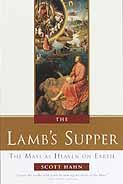
The Lamb's Supper

Of all things Catholic, there is nothing that is so familiar as the Mass. With its unchanging prayers, the Mass fits Catholics like their favorite clothes. Yet most Catholics sitting in the pews on Sundays fail to see the powerful supernatural drama that enfolds them. Pope John Paul II described the Mass as "Heaven on Earth," explaining that what "we celebrate on Earth is a mysterious participation in the heavenly liturgy."

The Lamb’s Supper reveals a long-lost secret of the Church: The early Christians' key to understanding the mysteries of the Mass was the New Testament Book of Revelation. With its bizarre imagery, its mystic visions of heaven, and its end-of-time prophecies, Revelation mirrors the sacrifice and celebration of the Eucharist.

Beautifully written, in clear direct language, bestselling Catholic author Scott Hahn's new book will help readers see the Mass with new eyes, pray the liturgy with a renewed heart, and enter into the Mass more fully, enthusiastically, intelligently, and powerfully than ever before.
This book was loaned to me by a western rights friend.  (I refuse to use the term "Catholic" with an adjective given the word's meaning.)  Not being of the western rights liturgy, I was not of the intended audience of the book.  I was not familiar with the Mass liturgy, so there is likely great information that I did not gather any knowledge from.  I do think Dr. Hahn wrote an excellent text concerning and supporting his understanding of the Mass.  He did help me as a Protestant understand my differences with my western rights and Orthodox brothers and sisters.  I do not have strong theological arguments with them.  My differences are strictly philosophical.

My western and eastern rights brothers and sisters focus heavily on the importance of the history of church liturgy.  The Mass and its connection with the Revelation is a chicken and egg argument, i.e., did the early Church fathers pattern their new method of worship after the Revelation or does the Revelation reveal the meaning of the Mass?  Dr. Hahn does not discuss this conundrum.  He assumes the second by axiom.

Since this is my blog, you get my thoughts on this subject.  I believe that this new method of worship that the Lord said nothing about was patterned after what the early church fathers knew: Judisim.  As the Church has grown and taken on other cultural histories, worship today looks different across the earth.  Is that wrong?  I believe not.  If the pattern of worship was important to the Lord, I believe He would have spoken on it.  Dr. Hahn quotes extensively from the Revelation because that is the focus of his text.  I am certain of his knowledge of the Scripture, but there are two I will quote that I believe ends the argument.

For you are saved by grace through faith, and this is not from yourselves; it is God’s gift — not from works, so that no one can boast. 

For freedom, Christ set us free. Stand firm then and don’t submit again to a yoke of slavery. 

Friday, February 9, 2018

The Pope Who Would Be King

Description
The Pulitzer Prize–winning author of The Pope and Mussolini takes on a pivotal, untold story: the bloody revolution that stripped the pope of political power and signaled the birth of modern Europe.

Days after his prime minister was assassinated in the middle of Rome in November 1848, Pope Pius IX found himself a virtual prisoner in his own palace. The wave of revolution that had swept through Europe now seemed poised to put an end to the popes’ thousand-year reign over the Papal States, if not to the papacy itself. Disguising himself as a simple parish priest, Pius escaped through a back door. Climbing inside the Bavarian ambassador’s carriage, he embarked on a journey into a fateful exile.

Only two years earlier Pius’s election had triggered a wave of optimism across Italy. After the repressive reign of the dour Pope Gregory XVI, Italians saw the youthful, benevolent new pope as the man who would at last bring the Papal States into modern times and help create a new, unified Italian nation. But Pius found himself caught between a desire to please his subjects and a fear—stoked by the conservative cardinals—that heeding the people’s pleas would destroy the church. The resulting drama—with a colorful cast of characters, from Louis Napoleon and his rabble-rousing cousin Charles Bonaparte to Garibaldi, Tocqueville, and Metternich—was rife with treachery, tragedy, and international power politics.

David Kertzer is one of the world’s foremost experts on the history of Italy and the Vatican and has a rare ability to bring history vividly to life. With a combination of gripping, cinematic storytelling and keen historical analysis, rooted in an unprecedented richness of archival sources, The Pope Who Would Be King sheds fascinating new light on the end of rule by divine right in the west and the emergence of modern Europe.
This is likely one of the best history texts that I have ever read.  The author paints such a clear picture of the events and people involved that it read like a novel.  Though I knew the outcome of the events I still had hope and anticipation for the conclusion.  Very well done.  I highly recommend

Thursday, January 4, 2018

Our Country

Description

Friday, November 10, 2017

The Mafia's President

Unbeknownst to most people even now, the election of 1968 placed the patron saint of the Mafia in the White House. In other words, Richard Nixon would go on to not only lead a criminal presidency; he would be totally indebted to our nation’s top mobsters.

By 1969, thanks in large part to his long-time campaign manager and political advisor Murray Chotiner, a lawyer who specialized in representing mobsters, Nixon had participated in secret criminal dealings for more than 20 years with sketchy figures such as Mickey Cohen, Mob financial guru Meyer Lansky, Teamsters union chief Jimmy Hoffa, and New Orleans Mafia boss Carlos Marcello. And with Chotiner as one of his key behind-the-scenes advisors in the White House, Nixon's ties to the Mafia didn't end there. The Mafia’s President reveals a mind-blowing litany of favors Nixon exchanged with these sinister characters over decades, ranging from springing Jimmy Hoffa from prison to banning the federal government from using the terms “Mafia” and “La Cosa Nostra.”

Drawing on newly released government tapes, documents, and other fresh information, The Mafia’s President offers a carefully reported, deeply researched account of Richard Nixon’s secret connections to America’s top crime lords.
Author Don Fulsom has written an excellent history of Richard Nixon, the Mafia, Nixon's political career, and his connection to the Mafia.  I was amazed reading it.  Given the now known connections and even connections known at the time; If the 24-hour news cycle existed in the 60's, Nixon would never have been elected president or vice-president.  It is surprising to me that it took until 1973 before an illegal event was finally connected to Nixon for his removal from office.

I am very questioning of Nixon's involvement in the JFK assassination, but his tight connections with the Mafia makes for a compelling argument.  No matter the often repeated phrase of Nixon's, "I'm not a crook," it seems to me that he was a perfect example of a political crook.

It is interesting to me that I was born in 1974; the year a president resigned in disgrace to avoid impeachment.  Then, my son was born in 1998; the year a president was impeached but not removed from office.  I wonder if I will have a grandson born the year a president is removed from office.  I know; I know.  Correlation does not mean causal.

Sunday, September 10, 2017

The Slave-Trader's Letter-Book

Description
In 1858 Savannah businessman Charles Lamar, in violation of U.S. law, organized the shipment of hundreds of Africans on the luxury yacht Wanderer to Jekyll Island, Georgia. The four hundred survivors of the Middle Passage were sold into bondage. This was the first successful documented slave landing in the United States in about four decades and shocked a nation already on the path to civil war.

In 1886 the North American Review published excerpts from thirty of Lamar’s letters from the 1850s, reportedly taken from his letter book, which describe his criminal activities. However, the authenticity of the letters was in doubt until very recently. In 2009, researcher Jim Jordan found a cache of private papers belonging to Charles Lamar’s father, stored for decades in an attic in New Jersey. Among the documents was Charles Lamar’s letter book, confirming him as the author.

This book has two parts. The first recounts the flamboyant and reckless life of Lamar himself, including Lamar’s involvement in southern secession, the slave trade, and a plot to overthrow the government of Cuba. A portrait emerges at odds with Lamar’s previous image as a savvy entrepreneur and principled rebel. Instead, we see a man who was often broke and whose volatility sabotaged him at every turn. His involvement in the slave trade was driven more by financial desperation than southern defiance. The second part presents the “Slave-Trader’s Letter-Book.” Together with annotations, these seventy long-lost letters shed light on the lead-up to the Civil War from the remarkable perspective of a troubled, and troubling, figure.
The author does and excellent job of presenting an academic text in a very readable, and enjoyable fashion. As a student of U.S. southern history, this is a must read. The aspect of states desire to reopen slave trade in the 1850's and 60's is often overlooked.  Charles Lamar never thought.  His actions were short sighted and foolish.