Showing posts with label History. Show all posts

Monday, December 17, 2018

Exodus

Exodus is an international publishing phenomenon--the towering novel of the twentieth century's most dramatic geopolitical event. Leon Uris magnificently portrays the birth of a new nation in the midst of enemies--the beginning of an earthshaking struggle for power. Here is the tale that swept the world with its fury: the story of an American nurse, an Israeli freedom fighter caught up in a glorious, heartbreaking, triumphant era. Here is Exodus --one of the great best-selling novels of all time.

"Passionate summary of the inhuman treatment of the Jewish people in Europe, of the exodus in the nineteenth and twentieth centuries to Palestine, and of the triumphant founding of the new Israel." -- The New York Times


This book was recommended to me since I enjoy historical fiction.  I found the book enjoyable.  Uris created a great set of characters to tell the Jewish story of the formation of modern Israel.  Other reviewers that I have read have taken great issue with Uris portrayal of these events solely from the Jewish perspective.  Uris, being Jewish, has a far more significant relationship with the Jewish understanding then of an Arab knowledge.  In my reading of this book, the Palestinian Arabs are not portrayed as evil or antagonistic.  In his writing, only the British and outside Palestine Arabs are described as antagonizers.  I am confident that another book could be written from a Palestinian Arab viewpoint of the same events and be as engaging.

I am disgusted that I was not made aware in my history education of the details of the Jewish immigration into Palestine following World War II.  The story makes clear the evil behind the colonial rule.

Wednesday, November 7, 2018

Sherman Lead

Sherman Lead is the gripping story of a year flying the F-4 Phantom in combat during the Vietnam War, told through the eyes of a US Air Force fighter pilot. Operating out of Ubon Royal Thai Air Base, Thailand in 1968–69, Gail Peck and his squadron mates were tasked with flying combat missions into North Vietnam and Laos at this time as part of Operations Rolling Thunder and Steel Tiger.

The F-4 was heavily involved in the air-to-ground mission at this time, with targets being well defended by enemy anti-aircraft artillery and surface-to-air missiles. Gail Peck's arrival in-theater coincided with the beginning of electro-optical and laser guided "smart" bomb combat operations. There were periods of fierce combat interspersed with lulls, and the fighting was intense and unforgettable to those who participated. Some men lived through it, and others died without a clear understanding of why.

Written by a pilot who flew near-daily combat missions, this engrossing book is the story of one man, his colleagues, and his machine--the mighty F-4 Phantom--at war.
My father was an F-4 hydraulic mechanic during the Vietnam conflict until the F-4 was retired.  I grew up with love for the F-4.  When other guys were all about the F-14 due to Top Gun, I still loved the F-4. I was excited to read this book.  Peck did a great job relaying personal stories regarding his flying of the F-4 during the early Vietnam period.

Peck was a USAF pilot rather than Navy, so I was a little disappointed in that as a Navy brat.  Peck still relayed the strength of the jet during this period and its versatile use.  He also clearly shows from the stories how poorly the Vietnam conflict was executed by the US leadership.

I recommend this book to anyone with interest in the history of the Vietnam conflict or in air warfare.

Wednesday, October 10, 2018

Dear Fahrenheit 451

If you love to read, and presumably you do since you’ve picked up this book (!), you know that some books affect you so profoundly they forever change the way you think about the world. Some books, on the other hand, disappoint you so much you want to throw them against the wall. Either way, it’s clear that a book can be your new soul mate or the bad relationship you need to end.

In Dear Fahrenheit 451, librarian Annie Spence has crafted love letters and breakup notes to the iconic and eclectic books she has encountered over the years. From breaking up with The Giving Tree (a dysfunctional relationship book if ever there was one), to her love letter to The Time Traveler’s Wife (a novel less about time travel and more about the life of a marriage, with all of its ups and downs), Spence will make you think of old favorites in a new way. Filled with suggested reading lists, Spence’s take on classic and contemporary books is very much like the best of literature—sometimes laugh-out-loud funny, sometimes surprisingly poignant, and filled with universal truths.

A celebration of reading, Dear Fahrenheit 451 is for anyone who loves nothing more than curling up with a good book…and another, and another, and another!
I was at my local library for the first time since they had moved into a new building.  By the time I visited though, the building was no longer new.  I think the library had been in the building for about a year. (Don't judge me.)  My wife and daughter were going to be at an appointment for nearly an hour, and I had no desire to stay in a waiting room.  Library for an hour wins by a mile.

The library's front display had this book.  I rank Fahrenheit 451 as one of the greatest works of fiction of all time.  It should be required reading at all schools.  Fahrenheit 451 had such an impact on me that it continues to influence my thoughts on entertainment and censorship today over 35 years later.  When I read this book's title, I picked it up to check out with no concept about its subject.

Ms. Spence had me read her first book in short order.  I laughed at many of her letters and her relationships with books.  I understood entirely and enjoyed her personal reflections on these relationships.  Her relationship with JRR Tolkien's The Hobbit troubled me.  I wanted to argue with her and explain how she was wrong.  How could a man who gets TWO letters for his middle name not write great fiction?

I do have to admit to having developed somewhat of a crush on Ms. Spence in reading this book.  She likes books.  She's funny. She's cute.  Then I realized I didn't have a crush on Ms. Spence; I was projecting my feelings for my wife onto someone like her.  Sorry, Ms. Spence.  I have a beautiful wife.  I'm a dog person.  I like The Hobbit.  I don't think it would have worked out anyway. :)

Saturday, September 22, 2018

The Vikings

The favorite image of the Vikings is of tall red-headed men, raping and pillaging their way around the coast of Europe, stopping only to ransack monasteries and burn longships. But the violent Vikings of the 8th century became the pious Christians of the 11th century, who gave gold crosses to Christian churches and in whose areas of rule pagan idols were destroyed and churches were built. So how did this radical transformation happen, and why? What difference did it make to the Vikings, and to those around them, and what is their legacy today? This book takes a global look at this crucial period in Viking history, exploring all the major areas of Viking settlement. Written to be an accessible and engaging overview for the general reader.
I visited far northern Norway in 1996.  Norway brings to mind Vikings.  The coast, fjords, architecture, and the language drips with the thought of Vikings.  Many people are enamored with the view of Vikings.  I am not one of those people.  The subtitle of this book is what interested me.  How did the Norse people go from being raiders to Christian in a relatively short period of time?  Martyn Whittock and Whittock tell the story of these people well.

Reading a history textbook does not sound enjoyable.  Most times it is not fun.  The tale of the Vikings becoming a Christian people is interesting.  Whittock and Whittock performed yeoman's work in research.  Their presentation goes beyond a research book.  There are few, if any, stories of individual Norse people but it is easy to view these people and the change their world must have gone through.

This book is an easy read for someone with interest in Viking history.  I believe this book would make an excellent addition to an academic course in any medieval history of Europe also.

Thursday, September 13, 2018

We Are Not Refugees

Never in history have so many people been displaced by political and military conflicts at home--more than 65 million globally. Unsparing, outspoken, vital, We Are Not Refugees tells the stories of many of these displaced, who have not been given asylum.

For over a decade, human rights journalist Agus Morales has journeyed to the sites of the world's most brutal conflicts and spoken to the victims of violence and displacement. To Syria, Afghanistan, Pakistan, and the Central African Republic. To Central America, the Congo, and the refugee camps of Jordan. To the Tibetan Parliament in exile in northern India.

We are living in a time of massive global change when negative images of refugees undermine the truth of their humiliation and suffering. By bringing us stories that reveal the personal pain and the global scope of the crisis, Morales reminds us of the fact and appeals to our conscience.
I still wonder why I picked this book to read from those suggested for me by NetGalley.  A book about refugees?  That sounds fun.  Then I remembered that several of my ancestors would have been refugees if they had wanted to go home rather than immigrate.  Those who fled Islamic radicalism and government exclusion.  These are my roots, and I have a long forgotten connection to these people today.

Morales invited me into the lives of these people, like me, running with their families from their homes.  They have no desire to run.  No desire to leave.  They love their homes, countries, and neighborhoods.  War has forced them to leave.  Their homes were taken from them.  And, they have nowhere to go.  Closed borders, distrust, and dangerous routes have made them residents of inhuman "refugee" camps.

These are not stories that are heard in the news.  These are not stories that are told by politicians in the United States.  These are people that I have been shown to fear.  These are the people that the United States, and by extension, I, are preventing from protecting an providing for here; the land of opportunity; the nation of immigrants.

What is truly interesting about this book is that Morales so pulled me into these lives that I, a right-center individual, would want to bring as many of these fleeing people as possible into my country, into my town, into my house.

Saturday, September 1, 2018

Accessible America

A History of Disability and Design
by Bess Williamson
Description
A history of design that is often overlooked—until we need it Have you ever hit the big blue button to activate automatic doors? Have you ever used an ergonomic kitchen tool? Have you ever used curb cuts to roll a stroller across an intersection? If you have, then you’ve benefited from accessible design—design for people with physical, sensory, and cognitive disabilities. These ubiquitous touchstones of modern life were once anything but. Disability advocates fought tirelessly to ensure that the needs of people with disabilities became a standard part of public design thinking. That fight took many forms worldwide, but in the United States it became a civil rights issue; activists used design to make an argument about the place of people with disabilities in public life. In the aftermath of World War II, with injured veterans returning home and the polio epidemic reaching the Oval Office, the needs of people with disabilities came forcibly into the public eye as they never had before. The U.S. became the first country to enact federal accessibility laws, beginning with the Architectural Barriers Act in 1968 and continuing through the landmark Americans with Disabilities Act in 1990, bringing about a wholesale rethinking of our built environment. This progression wasn’t straightforward or easy. Early legislation and design efforts were often haphazard or poorly implemented, with decidedly mixed results. Political resistance to accommodating the needs of people with disabilities was strong; so, too, was resistance among architectural and industrial designers, for whom the accessible design wasn’t “real” design. Williamson provides an extraordinary look at the everyday design, marrying accessibility with aesthetic, to give an insight into a world in which we are all active participants, but often passive onlookers. Richly detailed, with stories of politics and innovation, Bess Williamson’s Accessible America takes us through this critical history, showing how American ideas of individualism and rights came to shape the material world, often with unexpected consequences.
Most would look at a book about the history of design in America as strictly an academic text for research or design courses.  And this book is an excellent resource for both research and teaching.  I am neither a researcher in disability design nor a student of industrial design.  Though I am not a member of the apparent intended audience, I thoroughly enjoyed this book.

A am an American with a disability that requires that I use a wheelchair.  I have benefited and continue to benefit from the history of accessibility in the United States.  It may be due to my imposed passion for accessibility that this book was so impactful and meaningful to me.  This book educated me about those who paved the curb-cut and reasonable sloped road that I now get to travel down.  These individuals are no longer unknown to me but are people I am now thankful to and for.

Wednesday, July 11, 2018

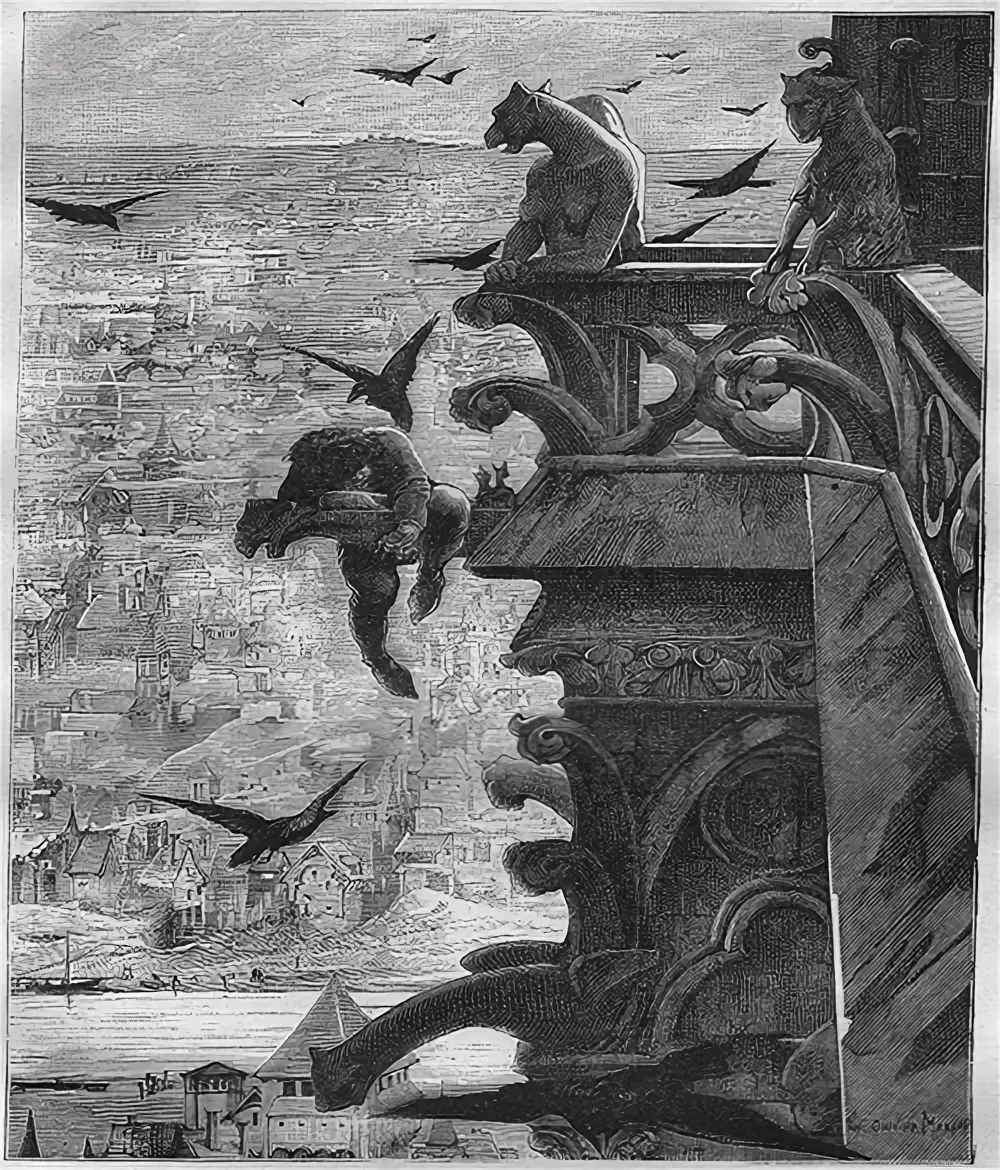
The Hunchback of Notre-Dame

From Wikipedia, the free encyclopedia

The Hunchback of Notre-Dame (FrenchNotre-Dame de Paris, "Our Lady of Paris") is a French Romantic/Gothic novel by Victor Hugo, published in 1831. The original French title refers to Notre Dame Cathedral, on which the story is centered. Frederic Shoberl's 1833 English translation was published as The Hunchback of Notre Dame which became the generally used title in English. The story is set in Paris in 1482 during the reign of Louis XI.

By Luc-Olivier Merson (1846–1920) (Here) [Public domain], via Wikimedia Commons
The Hunchback of Notre-Dame is such a ubiquitous piece of literature, I have felt required to read it to consider myself well-read.  Being only somewhat familiar with the story to start with, a lot of things surprised me that I think most who have not read the book assume wrongly to be true.  Hugo wrote this book as a story focusing on the architecture of Paris.  It is interesting to read a historical fiction book written in the 19th century about the 15th century.

The architectural focus of the book becomes apparent in a few chapters.  These chapters bored me.  They read like a history textbook.  It is not often that Hugo fell into this writing, but when he does the story suffers a long pause.  I did not know the history of the book until I read the history on Wikipedia.  These long story breaks then made sense.  I must confess that if I had known, I would have skipped the architecture sections like I did the Hobbit's songs in The Lord of the Rings the first time I read it.

I did love the read.  As a modern reader, Hugo's writing reminded me of Ernest Hemingway in his use of symbolism throughout that is difficult to overlook.  The story evoked memories of Stephen King in its complex character interactions that end in dread and pain.  The only drawback to the story is some of the predictability.  The revealed relationships were always expected, but I am a modern reader.  Much of what I have read before has likely been affected by Hugo causing me to expect the revelations.

The Kindle version I read was developed by Project Gutenberg.  Project Gutenberg has numerous public domain book available in ebook and audiobook formats.  Before paying for a public domain ebook or audiobook, check Project Gutenberg.  Instead of supporting the overprice of public domain ebooks by retailers, you could download the Project Gutenberg book and donate the retail price to them.

Sunday, June 17, 2018

A River in Darkness: One Man's Escape from North Korea

Born in 1947 in Kawasaki, Japan, Masaji Ishikawa moved with his parents and three sisters to North Korea in 1960 at the age of thirteen, where he lived until his escape in 1996. He currently resides in Japan.
Mr. Ishikawa engagingly told his story.  I kept wanting his circumstances to improve as the book went on even though I knew they would not.  The life that he and his family had to live in the DPRK and the way that was fooled by numerous governments at the time to move to the DPRK is disgusting.  The cruel way that his family was treated in the DPRK is disgusting.  What is even more horrific to me is that Mr. Ishikawa's story is not unique.

Wednesday, May 16, 2018

The Price of Greatness

An incisive account of the tumultuous relationship between Alexander Hamilton and James Madison and of the origins of our wealthy yet highly unequal nation
In the history of American politics, there are few stories as enigmatic as that of Alexander Hamilton and James Madison's bitterly personal falling out. Together they helped bring the Constitution into being, yet soon after the new republic was born, they broke over the meaning of its founding document. Hamilton emphasized economic growth, Madison the importance of republican principles.
Jay Cost is the first to argue that both men were right--and that their quarrel reveals a fundamental paradox at the heart of the American experiment. He shows that each man in his own way came to accept corruption as a necessary cost of growth. The Price of Greatness reveals the trade-off that made the United States the wealthiest nation in human history, and that continues to fracture our politics to this day.
My study of history did not provide a compare and contrast of Madison and Hamilton.  Mr. Cost provides an excellent comparison of the political philosophy of Madison and Hamilton.  He also teaches a beautiful truth for all statesmen through Hamilton.  Though one may believe they know a person or people, they are not necessarily dependable when placed in a situation of personal gain versus national interest.  Mr. Cost also points out the change that happened in our founders as time past.  Madison accepted Hamilton's views as Madison took on other responsibilities.

This book was a pleasure to read and filled in my understanding of 18th century America.  The only negative that I can type of this book is actually a statement of my vocabulary.  I found the Kindel's dictionary very useful.  Mr. Cost used words that I was unfamiliar with.  My assessment of my own vocabulary was adjusted.

Tuesday, April 17, 2018

Fortune's Favorites

With incomparable storytelling skill, New York Times bestselling author Colleen McCullough brings Rome alive in all her majesty—and illuminates the world of those favored by the gods at birth.

In a time of cataclysmic upheaval, a bold new generation of Romans vied for greatness amid the disintegrating remnants of their beloved Republic. They were the chosen...and the cursed—blessed with wealth and privilege yet burdened by the dictates of destiny in a savage struggle for power that would leave countless numbers crushed and destroyed. But there was one who would tower above them all—a brilliant and beautiful boy whose ambition was unparalleled, whose love was legend, and whose glory was Rome's: a boy they would one day call "Caesar."


This third book in the Master's of Rome series was another enjoyable read by McCullough.  She is such an excellent writer, I believe she could take boring parts of history and make them enjoyable.  Fortune's Favorites seems like a transition for the series.  Sulla dies.  The Spartican revolt is put down.  The republic struggles to continue to exist under the Sulla constitution.  And Gaius Julius Caesar rises.

Though this is a buffer book, it continues a great series that is a joy to read.  The fall of the republic is far to similar to our "republic".

Monday, April 2, 2018

The Brink

The incredible story of the 1983 war game that triggered a tense, brittle period of nuclear brinkmanship between the United States and the former Soviet Union.

What happened in 1983 to make the Soviet Union so afraid of a potential nuclear strike from the United States that they sent mobile ICBMs (intercontinental ballistic missiles) into the field, placing them on a three-minute alert?

Marc Ambinder explains the anxious period between the United States and the Soviet Union from 1982 to 1984, with the “Able Archer ’83” war game as the fulcrum of the tension. With astonishing and clarifying new details, he recounts the scary series of the close encounters that tested the limits of ordinary humans and powerful leaders alike. Ambinder explains how political leadership ultimately triumphed over misunderstandings, helping the two countries maintain a fragile peace.

Ambinder provides a comprehensive and chilling account of the nuclear command and control process, from intelligence warnings to the composition of the nuclear codes themselves. And he affords glimpses into the secret world of a preemptive electronic attack that scared the Soviet Union into action. Ambinder’s account reads like a thriller, recounting the spy-versus-spy games that kept both countries—and the world—in check.

From geopolitics in Moscow and Washington to sweat-caked soldiers fighting in the trenches of the Cold War, to high-stakes war games across NATO and the Warsaw Pact, The Brink serves as the definitive intelligence, nuclear, and national security history of one of the most precarious times in recent memory.
This book is an excellent telling of the end of the cold war and one of the near nuclear conflicts that occurred.  Having grown up in the 1980s, much of this book filled in the truth of the time that I was not aware.  The fear of the Soviet Union I understood well.  The Soviet fear of the United States surprised me.  I had never thought of my country as a threat to another.

The author does a great job of outlining the problems of Mutually Assured Destruction diplomacy.  He explains the efforts that President Reagan had to goto to engage the Soviets directly.  The complete lack of trust that the State Department had for the Soviets and the President surprised me.  I never realized the difficulty of implementing a new approach by a president.  The bureaucracy does run the town.

Friday, February 9, 2018

The Pope Who Would Be King

Description
The Pulitzer Prize–winning author of The Pope and Mussolini takes on a pivotal, untold story: the bloody revolution that stripped the pope of political power and signaled the birth of modern Europe.

Days after his prime minister was assassinated in the middle of Rome in November 1848, Pope Pius IX found himself a virtual prisoner in his own palace. The wave of revolution that had swept through Europe now seemed poised to put an end to the popes’ thousand-year reign over the Papal States, if not to the papacy itself. Disguising himself as a simple parish priest, Pius escaped through a back door. Climbing inside the Bavarian ambassador’s carriage, he embarked on a journey into a fateful exile.

Only two years earlier Pius’s election had triggered a wave of optimism across Italy. After the repressive reign of the dour Pope Gregory XVI, Italians saw the youthful, benevolent new pope as the man who would at last bring the Papal States into modern times and help create a new, unified Italian nation. But Pius found himself caught between a desire to please his subjects and a fear—stoked by the conservative cardinals—that heeding the people’s pleas would destroy the church. The resulting drama—with a colorful cast of characters, from Louis Napoleon and his rabble-rousing cousin Charles Bonaparte to Garibaldi, Tocqueville, and Metternich—was rife with treachery, tragedy, and international power politics.

David Kertzer is one of the world’s foremost experts on the history of Italy and the Vatican and has a rare ability to bring history vividly to life. With a combination of gripping, cinematic storytelling and keen historical analysis, rooted in an unprecedented richness of archival sources, The Pope Who Would Be King sheds fascinating new light on the end of rule by divine right in the west and the emergence of modern Europe.
This is likely one of the best history texts that I have ever read.  The author paints such a clear picture of the events and people involved that it read like a novel.  Though I knew the outcome of the events I still had hope and anticipation for the conclusion.  Very well done.  I highly recommend

Wednesday, January 17, 2018

Demanding Liberty

Religious liberty is one of the most contentious political issues of our time. How should people of faith engage with the public square in a pluralist era? Some citizens hope to reclaim a more Christian vision of national identity, while others resist any religious presence at all. This dispute is not new, and it goes back to the founding era of American history. As the country was being formed, some envisioned a Christian nation where laws would require worship attendance and Sabbath observance. Others advocated for a thoroughly secular society where faith would have no place in public life. But neither extreme won the day, thanks to the unsung efforts of a Connecticut pastor who forged a middle way. Historian Brandon O'Brien unveils an untold story of how religious liberty came to be. Between the Scylla and Charybdis of theocracy and secularism, Baptist pastor Isaac Backus contended for a third way. He worked to secure religious liberty and freedom of conscience for all Americans, not just for one particular denomination or religious tradition. Backus's theological ideas had social consequences, giving us insights into how people of faith navigate political debates and work for the common good. Backus lived in an age of both religious revival and growing secularism, competing forces much like those at work today. Then and now, people fiercely argue about the role of government and the limits of liberty. The past speaks into the present as we continue to demand liberty and justice for all.
Mr. Brandon J. O'Brien investigates the spiritual life of Isaac Backus in an engaging and capturing manner.  The influence of the first Great Awakening in Mr. Backus's life and his drawn out separation from the Congregationalist church of his youth was shown to have a large influence in Mr. Backus's drive for religious freedom in the newly formed country.  Backus's study, letters, speeches, and passion for the freedom of religion is laid out clearly.  Mr. O'Brien has written a book about a man that I believe should be a vital portion of every Americans education.  I highly recommend this book to every American.  Isaac Backus was a central figure in the freedom's that Americans currently enjoy.

Thursday, January 4, 2018

Our Country

Description

Friday, December 15, 2017

Surely You're Joking, Mr. Feynman

From Publishers Weekly
History will remember Nobel Prize-winning physicist Feynman (1918–1988), for his work in quantum physics and his role in the investigation of the explosion of the Challenger space shuttle. Contemporary readers and listeners, however, will remember him best for his reputation as a free-thinking iconoclast whose personal adventures were hilarious, insightful and inspiring. Todd does a fabulous job of conveying Feynman's infectious enthusiasm and childlike sense of wonder with his energetic portrayal of the scientist. He's adept even in difficult sections, such as when Feynman "speaks Italian" and "Chinese"—inventing completely made-up but accurate sounding languages. Todd does a good job of portraying Feynman's inquisitive manner and conveys the book's message and attitude with aplomb. While he sounds nothing like the late physicist (Feynman— the subject of James Gleick's Genius—had a thick Long Island accent and sounded more like a cross between Yogi Bear and The Honeymooners' Ed Norton), Todd's clean, polite voice is a revelation. Based on the Norton paperback. (Oct.)
Copyright © Reed Business Information, a division of Reed Elsevier Inc. All rights reserved.
Truthfully, I have wanted to read this book for years.  As a physicist, Dr. Feynman has always been somewhat of a goal and superhero to me.  I think that most physicist of the later part of the 20th century would likely agree.  This collection of stories recounted by Dr. Feynman is both very humorous and deeply saddening.  Through this book, I lost a significant amount of respect for Dr. Feynman.  His stories portrayed to me a man who never fully recovered from his first wife's death and became a misogynist.  Women became objects to him rather than people.  The tricks he played during the Manhatten project to demonstrate the true lack of security would now find one without a security clearance or in jail.  I can recommend this book but be prepared to lose respect for this great scientist.

Tuesday, November 21, 2017

Murder on Shades Mountain

One August night in 1931, on a secluded mountain ridge overlooking Birmingham, Alabama, three young white women were brutally attacked. The sole survivor, Nell Williams, 18, said a black man had held the women captive for four hours before shooting them and disappearing into the woods. That same night, a reign of terror was unleashed on Birmingham's black community: black businesses were set ablaze, posses of armed white men roamed the streets, and dozens of black men were arrested in the largest manhunt in Jefferson County history. Weeks later, Nell identified Willie Peterson as the attacker who killed her sister Augusta and their friend Jenny Wood. With the exception of being black, Peterson bore little resemblance to the description Nell gave the police. An all-white jury convicted Peterson of murder and sentenced him to death.
Most students of southern history are familiar with the Scottsboro Boys, but few are familiar with Willie Peterson, the murder of Shades mountain, and the trials.  The involvement of the Communist party in Jim Crow South was very involved.  I was not aware of this until reading this book.  This book on the history of the murders on Shades mountain is eye-opening and engaging.  It is both enjoying and disturbing to read.  I read this book every time I had a moment.  I knew the ending but was still hopeful for Peterson.

Friday, November 10, 2017

The Mafia's President

Unbeknownst to most people even now, the election of 1968 placed the patron saint of the Mafia in the White House. In other words, Richard Nixon would go on to not only lead a criminal presidency; he would be totally indebted to our nation’s top mobsters.

By 1969, thanks in large part to his long-time campaign manager and political advisor Murray Chotiner, a lawyer who specialized in representing mobsters, Nixon had participated in secret criminal dealings for more than 20 years with sketchy figures such as Mickey Cohen, Mob financial guru Meyer Lansky, Teamsters union chief Jimmy Hoffa, and New Orleans Mafia boss Carlos Marcello. And with Chotiner as one of his key behind-the-scenes advisors in the White House, Nixon's ties to the Mafia didn't end there. The Mafia’s President reveals a mind-blowing litany of favors Nixon exchanged with these sinister characters over decades, ranging from springing Jimmy Hoffa from prison to banning the federal government from using the terms “Mafia” and “La Cosa Nostra.”

Drawing on newly released government tapes, documents, and other fresh information, The Mafia’s President offers a carefully reported, deeply researched account of Richard Nixon’s secret connections to America’s top crime lords.
Author Don Fulsom has written an excellent history of Richard Nixon, the Mafia, Nixon's political career, and his connection to the Mafia.  I was amazed reading it.  Given the now known connections and even connections known at the time; If the 24-hour news cycle existed in the 60's, Nixon would never have been elected president or vice-president.  It is surprising to me that it took until 1973 before an illegal event was finally connected to Nixon for his removal from office.

I am very questioning of Nixon's involvement in the JFK assassination, but his tight connections with the Mafia makes for a compelling argument.  No matter the often repeated phrase of Nixon's, "I'm not a crook," it seems to me that he was a perfect example of a political crook.

It is interesting to me that I was born in 1974; the year a president resigned in disgrace to avoid impeachment.  Then, my son was born in 1998; the year a president was impeached but not removed from office.  I wonder if I will have a grandson born the year a president is removed from office.  I know; I know.  Correlation does not mean causal.

Sunday, September 10, 2017

The Slave-Trader's Letter-Book

Description
In 1858 Savannah businessman Charles Lamar, in violation of U.S. law, organized the shipment of hundreds of Africans on the luxury yacht Wanderer to Jekyll Island, Georgia. The four hundred survivors of the Middle Passage were sold into bondage. This was the first successful documented slave landing in the United States in about four decades and shocked a nation already on the path to civil war.

In 1886 the North American Review published excerpts from thirty of Lamar’s letters from the 1850s, reportedly taken from his letter book, which describe his criminal activities. However, the authenticity of the letters was in doubt until very recently. In 2009, researcher Jim Jordan found a cache of private papers belonging to Charles Lamar’s father, stored for decades in an attic in New Jersey. Among the documents was Charles Lamar’s letter book, confirming him as the author.

This book has two parts. The first recounts the flamboyant and reckless life of Lamar himself, including Lamar’s involvement in southern secession, the slave trade, and a plot to overthrow the government of Cuba. A portrait emerges at odds with Lamar’s previous image as a savvy entrepreneur and principled rebel. Instead, we see a man who was often broke and whose volatility sabotaged him at every turn. His involvement in the slave trade was driven more by financial desperation than southern defiance. The second part presents the “Slave-Trader’s Letter-Book.” Together with annotations, these seventy long-lost letters shed light on the lead-up to the Civil War from the remarkable perspective of a troubled, and troubling, figure.
The author does and excellent job of presenting an academic text in a very readable, and enjoyable fashion. As a student of U.S. southern history, this is a must read. The aspect of states desire to reopen slave trade in the 1850's and 60's is often overlooked.  Charles Lamar never thought.  His actions were short sighted and foolish.

Thursday, August 31, 2017

Silencing the Bomb

In December 2016, the Bulletin of Atomic Scientists moved their iconic "Doomsday Clock" thirty seconds forward to two and a half minutes to midnight, the latest it has been set since 1952, the year of the first United States hydrogen bomb test. But a group of scientists—geologists, engineers, and physicists—has been fighting to turn back the clock. Since the dawn of the Cold War, they have advocated a halt to nuclear testing, their work culminating in the Comprehensive Test Ban Treaty, which still awaits ratification from China, Iran, North Korea—and the United States. The backbone of the treaty is every nation's ability to independently monitor the nuclear activity of the others. The noted seismologist Lynn R. Sykes, one of the central figures in the development of the science and technology used in monitoring, has dedicated his career to halting nuclear testing. In Silencing the Bomb, he tells the inside story behind scientists' quest for disarmament.

Called upon time and again to testify before Congress and to inform the public, Sykes and his colleagues were, for much of the Cold War, among the only people on earth able to say with certainty when and where a bomb was tested and how large it was. Methods of measuring earthquakes, researchers realized, could also detect underground nuclear explosions. When politicians on both sides of the Iron Curtain attempted to sidestep disarmament or test ban treaties, Sykes was able to deploy the nascent science of plate tectonics to reveal the truth. Seismologists' discoveries helped bring about treaties limiting nuclear testing, but it was their activism that played a key role in the quest for peace. Full of intrigue, international politics, and hard science used for the global good, Silencing the Bomb is a timely and necessary chronicle of one scientist's efforts to keep the clock from striking midnight.
This book is an excellent insiders tale of nuclear testing and limiting.  The author explains the science behind verification clearly.  This is scientific history at its best.  Dr. Sykes played a central role in the limiting of nuclear testing and the ability to verify the following of the treaties agreed to.  As a geoscientist of off earth phenomena, I found the book fascinating.  Having worked in missile defense for decades, I am familiar with the results of some of his work.  He reaches conclusions regarding arms limitation treaties that are different than I, but I see the current world differently than he does.  Dr. Sykes still views the world as a primarily bilateral nuclear threat.  I see the world where the Nuclear Nonproliferation Treaty has become of limited importance.  Where clandestine nuclear weapons are shared at will with numerous countries.  Dr. Sykes does make a point of covering the numerous missed opportunities that we have had to limit nuclear proliferation that were missed.