Showing posts with label Fiction. Show all posts

Friday, February 1, 2019

Beyond the Tower (The Journey Series (Fairytales Retold) Book 1)

Raised by a witch, imprisoned her whole life, does this fairytale maiden know what freedom is?
Rapunzel has never spoken to anyone except for the witch that keeps her imprisoned in a tower. She has never had a friend, never wandered free. But when she breaks the witch's most sacred rule, she is cast from her tower and thrown into a world of bewildering people. She meets a princess in disguise, stumbles upon a murder, and is chased by Bluebeard. As her feet keep her moving, will she ever honestly find the answers she's looking for?
Ms. Roe has taken the known fairy tale to a greater understanding. She expounds beyond the common to create a relatable adolescent girl. The language is beautiful and engaging. I was wrapped up in the story by her choice of words. Though the book is YA focused, I have no reservations recommending it to all readers.

Monday, December 17, 2018

Exodus

Exodus is an international publishing phenomenon--the towering novel of the twentieth century's most dramatic geopolitical event. Leon Uris magnificently portrays the birth of a new nation in the midst of enemies--the beginning of an earthshaking struggle for power. Here is the tale that swept the world with its fury: the story of an American nurse, an Israeli freedom fighter caught up in a glorious, heartbreaking, triumphant era. Here is Exodus --one of the great best-selling novels of all time.

"Passionate summary of the inhuman treatment of the Jewish people in Europe, of the exodus in the nineteenth and twentieth centuries to Palestine, and of the triumphant founding of the new Israel." -- The New York Times


This book was recommended to me since I enjoy historical fiction.  I found the book enjoyable.  Uris created a great set of characters to tell the Jewish story of the formation of modern Israel.  Other reviewers that I have read have taken great issue with Uris portrayal of these events solely from the Jewish perspective.  Uris, being Jewish, has a far more significant relationship with the Jewish understanding then of an Arab knowledge.  In my reading of this book, the Palestinian Arabs are not portrayed as evil or antagonistic.  In his writing, only the British and outside Palestine Arabs are described as antagonizers.  I am confident that another book could be written from a Palestinian Arab viewpoint of the same events and be as engaging.

I am disgusted that I was not made aware in my history education of the details of the Jewish immigration into Palestine following World War II.  The story makes clear the evil behind the colonial rule.

Thursday, November 8, 2018

Moby Dick

The book is sailor Ishmael's narrative of the obsessive quest of Ahab, captain of the whaling ship Pequod, for revenge on Moby Dick, the white whale that on the ship's previous voyage bit off Ahab's leg at the knee. A contribution to the literature of the American Renaissance, the work's genre classifications range from late Romantic to early SymbolistMoby-Dick was published to mixed reviews, was a commercial failure, and was out of print at the time of the author's death in 1891. Its reputation as a "Great American Novel" was established only in the 20th century, after the centennial of its author's birth. William Faulkner confessed he wished he had written the book himself,[1] and D. H. Lawrence called it "one of the strangest and most wonderful books in the world" and "the greatest book of the sea ever written".[2] Its opening sentence, "Call me Ishmael", is among world literature's most famous.[3]“Moby-Dick.” Wikipedia, Wikimedia Foundation, 2 Nov. 2018, en.wikipedia.org/wiki/Moby-Dick.
This is a ubiquitous text in the West.  We reference it.  We talk about Ahab.  Everyone is familiar with the first line, "Call me Ishmael."  We even visit a coffee chain named after the first mate, Starbuck; but I find that many have not read this text.  I was never required to in secondary or university studies.  Therefore, in keeping with my drive to read books people talk about but haven't read, I read Moby-Dick.

This was a long book.   Herman Melville wrote two books in one from my view.  He wrote an excellent tale with foreshadowing, symbology, and unique language that included a dry and dull text of the details of whaling.  This structure reminded me very much of The Hunchback of Norte Dame.  The clear example of the unrelenting pursuit of a prize regardless the cost is clear.

Had Melville had an editor, I believe he would have sold more books in his lifetime, and his fame may have existed before his death.  The sheer volume of this text likely discouraged many from purchasing.  A book of 135 chapters must have had quite a price tag in the mid 19th century.  My brother told me when I first began reading it that it would remind me of Hugo in the mixture of story and banal information.  It did.

I actually didn't visually read the text.  Since I knew the book to be in the public domain, I first went to Project Gutenberg to download a Kindle version.  While on the site, I saw that an audio version was available.  Rather than loading up my Kindle, I downloaded the audio version which was actually produced by LibriVox.  The version I listened to was read by Stewart Wills.  His reading rivals any professional audiobook I have ever listened to.  Very high quality.

Moby Dick is a book worthy of the respect that it receives.

Thursday, October 18, 2018

The October Country

Welcome to a land Ray Bradbury calls "the Undiscovered Country" of his imagination--that vast territory of ideas, concepts, notions, and conceits where the stories you now hold were born. America's premier living author of short fiction, Bradbury has spent many lifetimes in this remarkable place--strolling through empty, shadow-washed fields at midnight; exploring long-forgotten rooms gathering dust behind doors bolted years ago to keep strangers locked out.. and secrets locked in. The nights are longer in this country. The cold hours of darkness move like autumn mists deeper and deeper toward winter. But the moonlight reveals great magic here--and a breathtaking vista. The October Country is many places: a picturesque Mexican village where death is a tourist attraction; a city beneath the city where drowned lovers are silently reunited; a carnival midway where a tiny man's most cherished fantasy can be fulfilled night after night. The October Country's inhabitants live, dream, work, die--and sometimes live again--discovering, often too late, the high price of citizenship. Here a glass jar can hold memories and nightmares; a woman's newborn child can plot murder, and a man's skeleton can war against him. Here there is no escaping the dark stranger who lives upstairs...or the reaper who wields the world. Each of these stories is a wonder, imagined by acclaimed tale-teller writing from a place shadows. But there is astonishing beauty in these shadows, born from a prose that enchants and enthralls. Ray Bradbury's The October Country is a land of metaphors that can chill like a long-after-midnight wind...as they lift the reader high above a sleeping Earth on the strange wings of Uncle Einar.
Having checked out the book Dear Fahrenheit 451, I had fond memories of reading the book Fahrenheit 451 by Ray Bradbury.  On the same library display shelf was this book of short stories by Ray Bradbury.  The short stories cover several decades of his writing.  The topics remain similar, but Bradbury's writing still obviously changed over that time.  To the better in my opinion.

Since it has been almost 100 years since he wrote some of these stories, they seem practically humorous to me where they were intended to be suspenseful.  My how times have changed.  Some of the stories were insightful and thought-provoking.  I will allow the reader to determine which ones.

Comparing these short stories to his masterpiece Fahrenheit 451 or to The Martian Chronicles would be unfair.  This is a modest collection of short stories but do not expect the Bradbury of F451.  Expect the Bradbury as a writer of Alfred Hitchcock Presents and The Twilight Zone.

Wednesday, October 10, 2018

Dear Fahrenheit 451

If you love to read, and presumably you do since you’ve picked up this book (!), you know that some books affect you so profoundly they forever change the way you think about the world. Some books, on the other hand, disappoint you so much you want to throw them against the wall. Either way, it’s clear that a book can be your new soul mate or the bad relationship you need to end.

In Dear Fahrenheit 451, librarian Annie Spence has crafted love letters and breakup notes to the iconic and eclectic books she has encountered over the years. From breaking up with The Giving Tree (a dysfunctional relationship book if ever there was one), to her love letter to The Time Traveler’s Wife (a novel less about time travel and more about the life of a marriage, with all of its ups and downs), Spence will make you think of old favorites in a new way. Filled with suggested reading lists, Spence’s take on classic and contemporary books is very much like the best of literature—sometimes laugh-out-loud funny, sometimes surprisingly poignant, and filled with universal truths.

A celebration of reading, Dear Fahrenheit 451 is for anyone who loves nothing more than curling up with a good book…and another, and another, and another!
I was at my local library for the first time since they had moved into a new building.  By the time I visited though, the building was no longer new.  I think the library had been in the building for about a year. (Don't judge me.)  My wife and daughter were going to be at an appointment for nearly an hour, and I had no desire to stay in a waiting room.  Library for an hour wins by a mile.

The library's front display had this book.  I rank Fahrenheit 451 as one of the greatest works of fiction of all time.  It should be required reading at all schools.  Fahrenheit 451 had such an impact on me that it continues to influence my thoughts on entertainment and censorship today over 35 years later.  When I read this book's title, I picked it up to check out with no concept about its subject.

Ms. Spence had me read her first book in short order.  I laughed at many of her letters and her relationships with books.  I understood entirely and enjoyed her personal reflections on these relationships.  Her relationship with JRR Tolkien's The Hobbit troubled me.  I wanted to argue with her and explain how she was wrong.  How could a man who gets TWO letters for his middle name not write great fiction?

I do have to admit to having developed somewhat of a crush on Ms. Spence in reading this book.  She likes books.  She's funny. She's cute.  Then I realized I didn't have a crush on Ms. Spence; I was projecting my feelings for my wife onto someone like her.  Sorry, Ms. Spence.  I have a beautiful wife.  I'm a dog person.  I like The Hobbit.  I don't think it would have worked out anyway. :)

Tuesday, October 2, 2018

Ragnarok Unwound

Prophecies don't untangle themselves.

Just ask Ikepela Ives, whose estranged mother left her with the power to unravel the binding threads of fate. Stuck with immortal power in a mortal body, Ives has turned her back on duty she never wanted.

But it turns out she can’t run from her fate forever, not now that Ragnarok has been set in motion and the god at the center of that tangled mess has gone missing. With a ragtag group of companions—including a brownie, a Valkyrie, and the goddess of death herself—Ives embarks on her first official mission as Fate Cipher—to save the world from doomsday.

Nothing she can't handle. Right?
This work is an exciting and surprising amalgamation of Norse and some Hawaiian mythology.  Jacques uses a simple main character that anyone can relate to as the center of real apocalypse avoiding story.  She does not utilize the tired understanding of Norse mythology to advance her story but instead introduces a story around and through the typical story.

Jacques leaves us with a story that can easily continue and expand to other mythologies and people.  I look forward to what I hope is a series of mixed mythology fiction.

Friday, September 7, 2018

The Psychology of Time Travel

In 1967, four female scientists worked together to build the world’s first time machine. But just as they are about to debut their creation, one of them suffers a breakdown, putting the whole project—and future of time travel—in jeopardy. To protect their invention, one member is exiled from the team—erasing her contributions from history.

Fifty years later, time travel is a big business. Twenty-something Ruby Rebello knows her beloved grandmother, Granny Bee, was one of the pioneers, though no one will tell her more. But when Bee receives a mysterious message from the future reporting the murder of an unidentified woman, Ruby becomes obsessed: could it be Bee? Who would want her dead? And most importantly of all: can her killing be stopped?

Traversing the decades and told from alternating perspectives, The Psychology of Time Travel introduces a fabulous new voice in fiction and a new must-read for fans of speculative fiction and women’s fiction alike.
The title of this book intrigued me.  The author, Kate Mascarenhas, is a first-time novelist.  I actually entered the book with meager expectations.  Most authors error in attempting to do time travel fiction; even those with numerous works behind them.  This work appeared to take a completely different approach to the oft-attempted plot device of time travel; Ms. Mascarenhas did and didn't disappoint.

When reading time travel fiction, I'm expecting the author to fall into the trap of paradoxes and plot holes.  Mascarenhas avoided creating any glaring ones that I caught and "black boxed" the ones that inevitably are created when doing science fiction.  I enjoyed her nonlinear time in writing and the beautiful symbolism to the plot.  I found myself in a time fog jumping from time to time attempting to follow the characters.  This is not bad writing IMHO, but the excellent and unexpected use of the craft of writing.  The effect that time travel could have on the psyche is an epistemological unknown.  Attempting to have a reader experience the result was creative and genius.

Well done Ms. Mascarenhas.  I look forward to your follow on novels.

Friday, August 24, 2018

The Picture of Dorian Gray

Oscar Wilde’s only full-length novel “The Picture of Dorian Gray” was first published in 1890 and is the classic tale of the moral decline of its title character, Dorian Gray. While Dorian has his portrait painted by Basil Hallward he is lectured to by Lord Henry Wotton, who espouses a hedonistic worldview. Dorian is drawn to Wotton’s belief that beauty and sensuality are the only things in life worth pursuing and wishes that he would stay young while his portrait changes instead. In the years that follow Dorian pursues a life of vice and debauchery, committing unspeakable acts along the way. With the passage of time, Dorian’s wish comes true, as his age and withering moral character are reflected in his portrait instead of himself. “The Picture of Dorian Gray” is arguably one of Wilde’s most popular works, which caused quite a scandal in Victorian England when it was first published, for its glorification of decadence. A chilling tale, “The Picture of Dorian Gray” is at once both an intricate character study and a sharp criticism of the improprieties of the Victorian age.

The Picture of Dorian GrayThe Picture of Dorian Gray by Oscar Wilde
My rating: 4 of 5 stars

Very dark and philosophical. Wilde is so descriptive of the setting that you can become lost in it.

View all my reviews


This is quite a disturbing book.  I did not know what the book was about when I began reading it.  Wilde's description of Dorian Gray as observed by Basil is so sensual, I was sure that the book was going to be about some gay attraction in Victorian England.  As I read farther, I realized the centrality of Dorian Gray's physical perfection to the plot.

It was easy to become lost in the setting of the book.  Wilde painted clearly the context at every turn.  The color of each flower.  The sound of each particular insect.  The tint of the reflection off of windows given the hour of the day.  I do not believe I have ever read a book with such attention to detail.  This symbolism becomes evident only after reaching deep into the story.

Though Wilde's tale was written in Victorian England, his work could have been penned today by King or Koontz with the same characters.  We as a global society are so consumed with beauty that the worth of the soul (the person) has become secondary.  I encourage everyone to read this book and take an in-depth look inside themselves.  What counts?  Would you sacrifice your soul for physical perfection?

Thursday, August 9, 2018

The Razor

Description
J. Barton Mitchell's The Razor is a riveting science fiction thriller about a man struggling to survive the chaos on a prison planet.

Brilliant engineer Marcus Flynn has been sentenced to 11-H37 alongside the galaxy’s most dangerous criminals. A hard labor prison planet better known as the Razor, where life expectancy is short and all roads are dead ends.

At least until the Lost Prophet goes active…

In a few hours, prison guards and staff are evacuated, the prisoners are left to die, and dark mysteries begin to surface.

Only Flynn has the skills and knowledge to unravel them, but he will have to rely on the most unlikely of allies--killers, assassins, pirates and smugglers. If they can survive each other they just might survive the Razor…and claim it for their own.
It has been some time since I've read or reviewed any sci-fi/fantasy books.  This was a welcoming reintroduction to the genre.  Mitchell did a great job with the world he created and remained consistent with it.  As a scientist, his setting impressed me and I kept waiting for him to err. So many authors do.

J. Baron Mitchell is new to me.  I looked on Amazon and saw that he is a prolific writer.  The Razor is not his first rodeo and it shows in his plot and character development.  Some aspects were predictable but much of it was surprising.

I don't want to say too much in the review to reveal anything that would be a spoiler.  What I will say is I can highly recommend this book.  Buy it as soon as it is available.

Monday, July 30, 2018

On Writing: A Memoir Of The Craft

Immensely helpful and illuminating to any aspiring writer, this special edition of Stephen King’s critically lauded, million-copy bestseller shares the experiences, habits, and convictions that have shaped him and his work.

“Long live the King” hailed Entertainment Weekly upon publication of Stephen King’s On Writing. Part memoir, part master class by one of the bestselling authors of all time, this superb volume is a revealing and practical view of the writer’s craft, comprising the necessary tools of the trade every writer must have. King’s advice is grounded in his vivid memories from childhood through his emergence as a writer, from his struggling early career to his widely reported, near-fatal accident in 1999—and how the inextricable link between writing and living spurred his recovery. Brilliantly structured, friendly and inspiring, On Writing will empower and entertain everyone who reads it—fans, writers, and anyone who loves a great story well told.
I bought this book after walking through a local brick and mortar bookstore.  This book was listed as required reading for a high school creative writing class.  I was quite surprised that Stephen King had written a book on writing and that the book was needed for a high school class.  My interest peaked, I bought it.  I was not disappointed.

King provides an autobiographical portion as his C.V.  From this, I came to understand King and his writing.  All authors, like all characters, have a backstory.  His is not pleasant.

He also provides excellent help for fiction writers, the pitfalls to avoid, and an encouragement for writing.  His directions for first steps for the author desiring to be published are invaluable.  I can recommend this book to anyone who enjoys writing fiction for personal enjoyment and to the aspiring professional fiction writer.

Wednesday, July 11, 2018

The Hunchback of Notre-Dame

From Wikipedia, the free encyclopedia

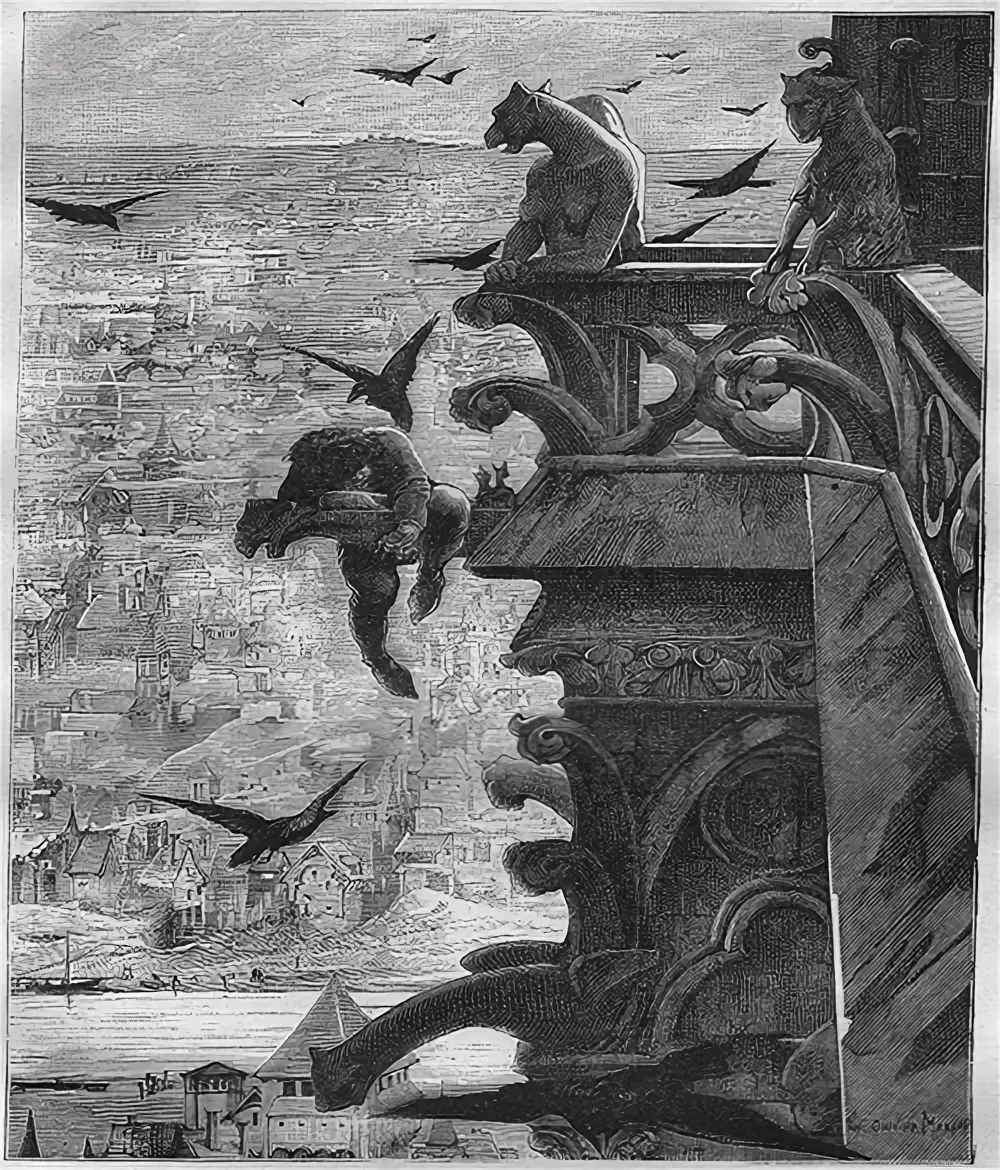
The Hunchback of Notre-Dame (FrenchNotre-Dame de Paris, "Our Lady of Paris") is a French Romantic/Gothic novel by Victor Hugo, published in 1831. The original French title refers to Notre Dame Cathedral, on which the story is centered. Frederic Shoberl's 1833 English translation was published as The Hunchback of Notre Dame which became the generally used title in English. The story is set in Paris in 1482 during the reign of Louis XI.

By Luc-Olivier Merson (1846–1920) (Here) [Public domain], via Wikimedia Commons
The Hunchback of Notre-Dame is such a ubiquitous piece of literature, I have felt required to read it to consider myself well-read.  Being only somewhat familiar with the story to start with, a lot of things surprised me that I think most who have not read the book assume wrongly to be true.  Hugo wrote this book as a story focusing on the architecture of Paris.  It is interesting to read a historical fiction book written in the 19th century about the 15th century.

The architectural focus of the book becomes apparent in a few chapters.  These chapters bored me.  They read like a history textbook.  It is not often that Hugo fell into this writing, but when he does the story suffers a long pause.  I did not know the history of the book until I read the history on Wikipedia.  These long story breaks then made sense.  I must confess that if I had known, I would have skipped the architecture sections like I did the Hobbit's songs in The Lord of the Rings the first time I read it.

I did love the read.  As a modern reader, Hugo's writing reminded me of Ernest Hemingway in his use of symbolism throughout that is difficult to overlook.  The story evoked memories of Stephen King in its complex character interactions that end in dread and pain.  The only drawback to the story is some of the predictability.  The revealed relationships were always expected, but I am a modern reader.  Much of what I have read before has likely been affected by Hugo causing me to expect the revelations.

The Kindle version I read was developed by Project Gutenberg.  Project Gutenberg has numerous public domain book available in ebook and audiobook formats.  Before paying for a public domain ebook or audiobook, check Project Gutenberg.  Instead of supporting the overprice of public domain ebooks by retailers, you could download the Project Gutenberg book and donate the retail price to them.

Saturday, June 2, 2018

Bohemians of the Latin Quarter

A classic novel, by Henry Murger, of Bohemian life. The story is a collection of loosely united chapters beginning with the first meeting of the four main characters and ending with their departure from Bohemia in favor of bourgeois life, published in 1851. Although it is commonly called a novel, it does not follow standard novel form. It is a collection of loosely related stories, all set in the Latin Quarter of Paris in the 1840s, romanticizing bohemian life in a playful way. Most of the stories were originally published individually in a local literary magazine, Le Corsaire. Many of them were semi-autobiographical, featuring characters based on actual individuals who would have been familiar to some of the magazine's readers.  The version I read was provided by Project Gutenberg.  

Project Gutenberg offers over 57,000 free eBooks. Choose among free epub books, free kindle books, download them or read them online. You will find the world's great literature here, with focus on older works for which copyright has expired. Thousands of volunteers digitized and diligently proofread the eBooks, for enjoyment and education.

La bohème is an opera in four acts, composed by Giacomo Puccini to an Italian libretto by Luigi Illica and Giuseppe Giacosa, based on this book.  The world premiere performance of La bohème was in Turin on 1 February 1896 at the Teatro Regio, conducted by the young Arturo Toscanini; its U.S. premiere took place the following year, 1897, in Los Angeles. Since then, La bohème has become part of the standard Italian opera repertory and is one of the most frequently performed operas worldwide.  The current musical Rent is based heavily on this opera.
I am a huge fan of the musical and movie Rent.  Given that, I felt compelled to read the original basis story.  It was fun to read and rather than attempt the correct pronunciations of the names, I just used the rent character's names in my head.  Of course, not all the characters crossed the stories, but it still worked for most.  Mimi was one that didn't change.  What I found interesting in the stories is the leaving of the bohemian life by all the living characters.  It was very much a coming of age story in that way.  The book really showed the bohemian life as a young life that cannot last.

Tuesday, April 24, 2018

The Green Mile

Stephen King’s classic #1 New York Times bestselling dramatic serial novel and inspiration for the Oscar-nominated film starring Tom Hanks!

Welcome to Cold Mountain Penitentiary, home to the Depression-worn men of E Block. Convicted killers all, each awaits his turn to walk “the Green Mile,” the lime-colored linoleum corridor leading to a final meeting with Old Sparky, Cold Mountain’s electric chair. Prison guard Paul Edgecombe has seen his share of oddities over the years working the Mile, but he’s never seen anything like John Coffey—a man with the body of a giant and the mind of a child, condemned for a crime terrifying in its violence and shocking in its depravity. And in this place of ultimate retribution, Edgecombe is about to discover the terrible, wondrous truth about John Coffey—a truth that will challenge his most cherished beliefs….
I regret having seen the movie before having read the book, or books as it were, as with most books made into movies.  King is such an excellent writer that it is almost a crime to not read his book but watch a video.  I am not a rabid (ha, ha, ha, ha) fan, but I have read several of his books.  This is by far the best of his works that I have read.

His descriptions are vivid.  He utilizes foreshadowing and symbolism skilfully.  I actually teared up in the last few pages.  I was moved by the characters and also that the book was coming to an end.  The only negative view of this work I have is that King is such a skillful writer I feel inadequate to write.

Of modern fiction writers, I believe King is the best.  I am not a fan of macabre.  Having read this great story of King's, I wished it wrote more like it.