Monday, August 20, 2018

Learning to Speak God from Scratch

As America rapidly becomes a pluralistic, postmodern society, many of us struggle to talk about faith. We can no longer assume our friends understand words such as grace or gospel. Others, like lost and sin, have become so negative they are nearly conversation-enders.

Jonathan Merritt knows this frustration well. After Jonathan moved from the Bible Belt to New York City, he discovered that whenever conversations turned to spirituality, the words he'd used for decades didn't connect with listeners anymore. In a search for answers and understanding, Jonathan uncovered a spiritual crisis affecting tens of millions.

In this groundbreaking book, one of America's premier religion writers revives ancient expressions through cultural commentary, vulnerable personal narratives, and surprising biblical insights. Both provocative and liberating, Learning to Speak God from Scratch will breathe new life into your spiritual conversations and lure you into the embrace of the God who inhabits them.
I encountered this book in an odd location for me to find reading material.  Listening to the Bad Christian podcast, they had Jonathan Merritt on discussing this book.  I was very intrigued by the discussion and the topic of the book.  Planning on launching a church focused on outreach to people who are not familiar with church, this book seemed a must read.

Merritt does a fantastic job writing an engaging book about a topic that one would assume is a snooze fest.  In one chapter I actually found myself weeping.  Those who are familiar with church lingo are lost in speaking to those who are not.  Isn't it the job of the church to reach out to those who are not in the church?  To share the good news?  This book explains quite clearly to those in the church that the words that we are used to using are no longer useful.  We must learn to speak God anew.

Wednesday, August 15, 2018

The Ape that Understood the Universe

The Ape that Understood the Universe is the story of the strangest animal in the world: the human animal. It opens with a question: How would an alien scientist view our species? What would it make of our sex differences, our sexual behavior, our child-rearing patterns, our moral codes, our religions, languages, and science? The book tackles these issues by drawing on ideas from two major schools of thought: evolutionary psychology and cultural evolutionary theory. The guiding assumption is that humans are animals, and that like all animals, we evolved to pass on our genes. At some point, however, we also evolved the capacity for culture - and from that moment, culture began evolving in its own right. This transformed us from a mere ape into an ape capable of reshaping the planet, traveling to other worlds, and understanding the vast universe of which were but a tiny, fleeting fragment.
I was very excited to read this book given the title and the excellent reviews that I had read.  The first chapter did not disappoint.  The second chapter, likewise, was an enjoyable read.  Beginning in the third chapter, it seems that Stewart-Williams lost the premise of the book and focussed on human sexual development more than other aspects.  The imagined alien became solely interested in sex.  There is so much more to the human animal than sex, but Stewart-Williams did not address those attributes.

Monday, August 13, 2018

A German Officer in Occupied Paris

Ernst Jünger was one of twentieth-century Germany’s most important—and most controversial—writers. Decorated for bravery in World War I and the author of the acclaimed memoir from the western front, Storm of Steel, he frankly depicted the war’s horrors even as he extolled its glories. As a Wehrmacht captain during the Second World War, Jünger faithfully kept a journal in occupied Paris and continued to write on the eastern front and in Germany until its defeat—writings that are of major historical and literary significance.

Jünger’s Paris journals document his Francophile excitement, romantic affairs, and fascination with botany and entomology, alongside mystical and religious ruminations and trenchant observations on the occupation and the politics of collaboration. Working as a mail censor, he led the privileged life of an officer, encountering artists such as Céline, Cocteau, Braque, and Picasso. His notes from the Caucasus depict chaos and misery after the defeat at Stalingrad, as well as candid comments about the atrocities on the eastern front. Returning to Paris, Jünger observed resistance and was peripherally involved in the 1944 conspiracy to assassinate Hitler. After fleeing France, he reunited with his family as Germany’s capitulation approached. Both participant and commentator, close to the horrors of history but often hovering above them, Jünger turned his life and experiences into a work of art. These wartime journals appear here in English for the first time, giving us fresh insight into the quandaries of the twentieth century from the keen pen of a paradoxical observer.

Ernst Jünger (1895–1998) was a major figure in twentieth-century German literature and intellectual life. He was a young leader of right-wing nationalism in the Weimar Republic, but although the Nazis tried to court him, Jünger steadfastly kept his distance from their politics. Among his works is On the Marble Cliffs, a rare anti-Nazi novel written under the Third Reich.
I had never before heard of Junger.  The book is mostly a collection of his journals over his stationing as an officer in Paris.  Given that, it reads like a diary.  Since I was not aware of Junger before reading, the book did not engage me.  Reading the journal of someone I don't know isn't interesting.  What was very interesting was his view as a German officer in the war.

I do not believe that Junger was a Nazi, but a German.  Many times in his journals it was clear that he did not support the fascist ideals. Knowing that he had burned many of his letters, he was likely cautious with what he recorded in his journals.

This book is an academic collection and is an excellent resource for history students an researchers.  For entertainment reading, I cannot recommend.

Thursday, August 9, 2018

The Razor

Description
J. Barton Mitchell's The Razor is a riveting science fiction thriller about a man struggling to survive the chaos on a prison planet.

Brilliant engineer Marcus Flynn has been sentenced to 11-H37 alongside the galaxy’s most dangerous criminals. A hard labor prison planet better known as the Razor, where life expectancy is short and all roads are dead ends.

At least until the Lost Prophet goes active…

In a few hours, prison guards and staff are evacuated, the prisoners are left to die, and dark mysteries begin to surface.

Only Flynn has the skills and knowledge to unravel them, but he will have to rely on the most unlikely of allies--killers, assassins, pirates and smugglers. If they can survive each other they just might survive the Razor…and claim it for their own.
It has been some time since I've read or reviewed any sci-fi/fantasy books.  This was a welcoming reintroduction to the genre.  Mitchell did a great job with the world he created and remained consistent with it.  As a scientist, his setting impressed me and I kept waiting for him to err. So many authors do.

J. Baron Mitchell is new to me.  I looked on Amazon and saw that he is a prolific writer.  The Razor is not his first rodeo and it shows in his plot and character development.  Some aspects were predictable but much of it was surprising.

I don't want to say too much in the review to reveal anything that would be a spoiler.  What I will say is I can highly recommend this book.  Buy it as soon as it is available.

Monday, July 30, 2018

On Writing: A Memoir Of The Craft

Immensely helpful and illuminating to any aspiring writer, this special edition of Stephen King’s critically lauded, million-copy bestseller shares the experiences, habits, and convictions that have shaped him and his work.

“Long live the King” hailed Entertainment Weekly upon publication of Stephen King’s On Writing. Part memoir, part master class by one of the bestselling authors of all time, this superb volume is a revealing and practical view of the writer’s craft, comprising the necessary tools of the trade every writer must have. King’s advice is grounded in his vivid memories from childhood through his emergence as a writer, from his struggling early career to his widely reported, near-fatal accident in 1999—and how the inextricable link between writing and living spurred his recovery. Brilliantly structured, friendly and inspiring, On Writing will empower and entertain everyone who reads it—fans, writers, and anyone who loves a great story well told.
I bought this book after walking through a local brick and mortar bookstore.  This book was listed as required reading for a high school creative writing class.  I was quite surprised that Stephen King had written a book on writing and that the book was needed for a high school class.  My interest peaked, I bought it.  I was not disappointed.

King provides an autobiographical portion as his C.V.  From this, I came to understand King and his writing.  All authors, like all characters, have a backstory.  His is not pleasant.

He also provides excellent help for fiction writers, the pitfalls to avoid, and an encouragement for writing.  His directions for first steps for the author desiring to be published are invaluable.  I can recommend this book to anyone who enjoys writing fiction for personal enjoyment and to the aspiring professional fiction writer.

Sunday, July 22, 2018

Miracles: What They Are, Why They Happen, and How They Can Change Your Life

The #1 bestselling author of Bonhoeffer and Martin Luther explores miracles in an inspiring response to the “New Atheists” 

Not since C. S. Lewis in 1947 has an author of Eric Metaxas’s stature undertaken a major exploration of the phenomenon of miracles. In this groundbreaking work, Metaxas examines the compatibility between faith and science and provides well-documented anecdotal evidence of actual miracles. With compelling—sometimes electrifying—evidence that there is something real to be reckoned with, Metaxas offers a timely, civil, and thoughtful answer to recent books by Richard Dawkins, Christopher Hitchens, and Sam Harris. Already a New York Times bestseller, Miracles will be welcomed by both believers and skeptics—who will find their minds opening to the possibilities.
I do not generally read "Christian" books.  I find that they tend to be poorly written, especially the attempts at fiction, and trite.  This book was recommended, on Facebook by my pastor from college.  A man that I have a lot of respect for.  After investigating Metaxas some, my interest was peaked.  An author who has come to be known for his biographies of great people wrote a book on the subject of miracles?  He must have an exciting view.  I was not disappointed.

Metaxas covers the philosophy, theology, and metaphysics of miracles while also writing accounts from people who experienced miracles.  In writing about miracles, Metaxas provides his own reasonable definition.  This provides a good foundation for the rest of the subject.  Metaxas delivers an excellent metaphysical reason for why some may experience a miracle, and another does not.

I cannot recommend the book enough.  If you have any curiosity concerning miracles or what some may have claimed as miracles, this is a must-read.  If you believe that all who think miracles have occurred are kooks, this is the book for you.

Wednesday, July 11, 2018

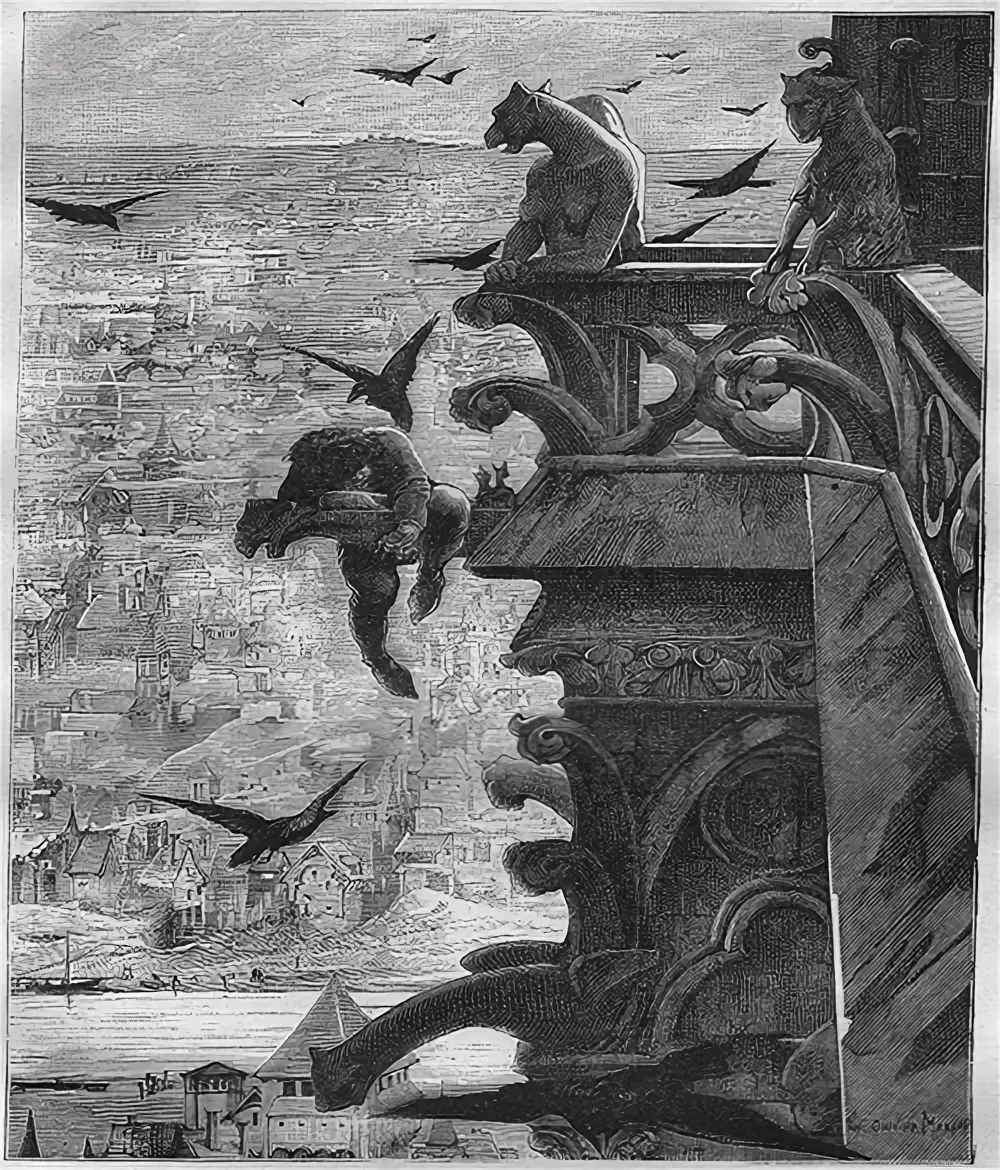
The Hunchback of Notre-Dame

From Wikipedia, the free encyclopedia

The Hunchback of Notre-Dame (French: Notre-Dame de Paris, "Our Lady of Paris") is a French Romantic/Gothic novel by Victor Hugo, published in 1831. The original French title refers to Notre Dame Cathedral, on which the story is centered. Frederic Shoberl's 1833 English translation was published as The Hunchback of Notre Dame which became the generally used title in English. The story is set in Paris in 1482 during the reign of Louis XI.

By Luc-Olivier Merson (1846–1920) (Here) [Public domain], via Wikimedia Commons
The Hunchback of Notre-Dame is such a ubiquitous piece of literature, I have felt required to read it to consider myself well-read.  Being only somewhat familiar with the story to start with, a lot of things surprised me that I think most who have not read the book assume wrongly to be true.  Hugo wrote this book as a story focusing on the architecture of Paris.  It is interesting to read a historical fiction book written in the 19th century about the 15th century.

The architectural focus of the book becomes apparent in a few chapters.  These chapters bored me.  They read like a history textbook.  It is not often that Hugo fell into this writing, but when he does the story suffers a long pause.  I did not know the history of the book until I read the history on Wikipedia.  These long story breaks then made sense.  I must confess that if I had known, I would have skipped the architecture sections like I did the Hobbit's songs in The Lord of the Rings the first time I read it.

I did love the read.  As a modern reader, Hugo's writing reminded me of Ernest Hemingway in his use of symbolism throughout that is difficult to overlook.  The story evoked memories of Stephen King in its complex character interactions that end in dread and pain.  The only drawback to the story is some of the predictability.  The revealed relationships were always expected, but I am a modern reader.  Much of what I have read before has likely been affected by Hugo causing me to expect the revelations.

The Kindle version I read was developed by Project Gutenberg.  Project Gutenberg has numerous public domain book available in ebook and audiobook formats.  Before paying for a public domain ebook or audiobook, check Project Gutenberg.  Instead of supporting the overprice of public domain ebooks by retailers, you could download the Project Gutenberg book and donate the retail price to them.